
Trapped Within An Abstract: Analysing Abstract (Psychopomp) by Hozier
mastery in the language of longing

Think of grief like a black smog that slowly settles in your chest. If you cough it out, you'll risk burning out your throat. If you let it stay, your lungs will char until nothing of it remains. That is exactly how one feels while listening to Abstract (Psychopomp) by Hozier. This song belongs to Hozier’s third studio album, Unreal Unearth, which is a loose concept album. Each song on this album calls back to scenes, phrases, characters or concepts from Dante Alighieri’s Inferno. This narrative poem details the poet’s descent into hell with magnificent descriptions of the circles of hell, exploring politics, sin, religion and the broader human condition.
The song starts with a heightened chord, almost as though announcing that something of finality is going to be said. And true to that, the song begins saying:
Sometimes it returns, like rain that you slept through
Think of clouds looming over your roof, the steady downpour, the animals rushing to safety, the people hurrying back home. Think of those that slip and wound themselves in the slush. Think of your exhaustion so bone deep that you sleep through this cruel falling.
When you wake up, all is quiet. The streets carry the memory of the wounds on its footpaths but bare open fresh streets. This is compared to the thought of a love long lost. Hozier then goes on to write: the feeling came late, I’m still glad I met you.
The heightened chord that first felt like the stabbing of a knife when we first heard it open the song, now twists into a sinking to say:
The memory hurts, but does me no harm
With this simple agony, the song progresses.
Hozier then evokes the images of things that shine: the glistening eyes of a poor animal struck by a vehicle on the road, the cold wet tip of his lover’s nose and the earth from a distance. I’m drawn to the description of the lover’s nose because it is something often only used to speak of animals. By doing so, we see a very vulnerable and helpless state of his lover beside that of the dying animal.
He then goes on to say:
Sometimes there's a thought, like you choose what you're doing
But it comes to naught when I look back through it
I remember the view, street lights in the dark blue
In an interview, Hozier spoke of a memory when he watched an animal being hit by a car. He spoke of the great compassion in the act of leaving everything behind and running into oncoming traffic to cradle and hopefully save the animal after. Here, the lover puts themselves in a position to be wounded and killed by the force of the speeding vehicles with no second thought just to hold the dying creature. And when you witness such compassion in someone, you have no choice:
The moment I knew I'd no choice but to love you
The song proceeds and Hozier once again describes the animal and the lover in this situation:
The fear in its eyes gone out in an instant
Your tear caught the light, the earth from a distance
We are then introducted to the idea of a psychopomp, a creature believed to guide dead souls into the afterlife. In Greek mythology, and in Dante’s Inferno, the psychopomp is Charon. He transports souls into the afterlife by rowing them in a boat across the river Styx.
The images evoked lead into the chorus which is a repeated: see how it shines. This idea of something shining in the eye is summoned throughout Dante’s Inferno in the verses where Charon ferries the poet into Hell.
In Canto 2 of Inferno, Dante introduces a character named Beatrice with whom he engages in dialogue. It is believed that this character was inspired by a woman with the same name whom Dante loved dearly.
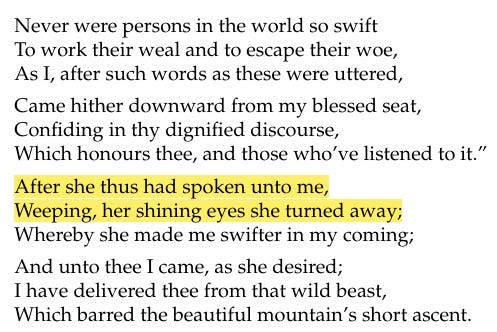
This is very similar to the image of the lover crying and her tear being caught in the light.
In Canto 3, Charon is described as having eyes with wheels of flames:
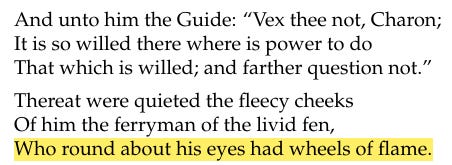
This description continues to state:
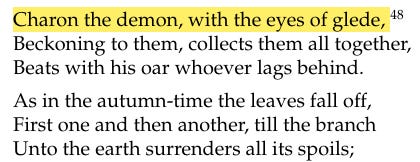
Glede is an archaic term referring to the glowing embers of coal. This imagery of Charon is seen even in Dryden’s Aeneid where his eyes are described as hollow furnaces on fire. In Canto 7, the water they are ferrying across is described as much more darker than perse, which is a purple-black colour. In that darkness, each star that was ascending has already sunk. The only light is that of the embers burning in the psychopomp’s eyes. And perhaps, the burning fear in the dead he is ferrying.
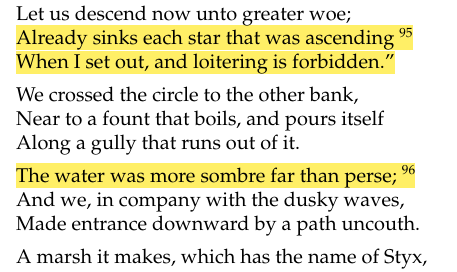
With this, we witness the lover in Hozier’s song transforming into the psychopomp. We witness the bleakness of the damage done, the tar of the roads, the darkness that prevented them from seeing the animal in the first place and finally, the glimpses of light that remain on the streets coming from their fearful eyes.
The animal’s fate is decided. But in his lover’s arms, she allows it a ferry, a death without fear. Imagine bleeding out in excruciating pain yet to have one shed a tear for you and hold you with such tenderness. All that life lived in torment might seem meaningful for a moment. Most people spend their whole lives seeking that one moment in a gentle hand.
Hozier then goes on to sing:
Darling, there's a part of me I'm afraid will always be
Trapped within an abstract from a moment of my life
And with this he captures the tragedy of it all. Think of what it means to be trapped within an abstract of a moment—an idea, that which is intangible of the already intangible & fragile memory. He goes on to describe how it felt: the weeds in the concrete, the speed of the traffic and states with finality:
All my love and terror balanced there between those eyes
And there it is—another twisting of the knife. A quiet confession of something so brutal. Love in all its doomed glory.
All the grand music stops, only a quiet piano accompanies his words. The song ends with a whispered incantation of see how it shines, almost reluctant to let go of the memory. Even if you do, you are trapped. And when trapped, you’re better off holding on than letting go anyway.
Please do Unknown/nth too 🤍
No one could do a better job at writing about my favourite hozier song. It's divine.